Fake News as a Digital Reality

As long as humanity has existed, so have lies. People lie to each other for a variety of reasons, but that is a completely different discussion. The phenomenon of “fake news” has come into the spotlight as digital media has risen to prominence and companies such as Facebook gain enormous power and influence in modern culture. Lawmakers and regular citizens have come to realize that Facebook is a platform notorious with misleading and downright false content, often intended to influence users. After the presidential election and others following, we have to accept that we are grossly undereducated and unprepared for understanding our Internet forums and what they are truly capable of. Fake news has tremendous power in today’s digitally oriented culture, and it is often more organized than we think.

This leaves us with the burning question: what can we do to combat this? I believe the better way to ask this is, “how can we better educate people to deal with this problem?” So many people are ignorant of fake content on the Internet simply because they don’t know how to recognize it. Think of your 70 year-old grandmother. She grew up where the main source of information came from large, traditional news outlets such as the New York Times or Washington Post. These were credible sources who more or less had a monopoly on mass distributed information. Today, she logs on to her Facebook and sees an endless stream of information that has not been vetted in the same way traditional mass media has in the past. Combating fake news is a two-step approach. First, we need to educate those who are already active in the digital landscape. There seem to be less institutional ways to do this effectively, so it is critical that those who understand fake news inform others of its dangers. If a friend shares something on Facebook or another social platform that is fake news, respectfully inform them of their wrongdoing and how they can recognize false information in the future. This can be done in the comments section, in a private message or in person. If we take it upon ourselves to kindly and respectfully educate our friends who may not understand fake news, one by one we can create a more digitally competent society.

I think where the real impact can be made in fake news education is in the next generation, those who are still in school and yet to enter digital media or are still novices. This can range from the earliest stages of education through college. Implementing digital competency courses into formal education means we can ensure the next generation of digital users will not make the same mistakes many of us have. Digital competency courses can and should be taught at young ages, perhaps even as young as fourth grade. Kids are getting their hands on social media and other online forums at younger and younger ages, so it is paramount that our education system prepare them for the challenges that come with digital citizenship. An introductory course early on is valuable, but it also would do students well to take an in-depth digital competency course in college. Many colleges, Creighton included, require students to take a large core of liberal arts classes in order to graduate. With the mission of this being a well-rounded, capable student, it would benefit everyone to include into this curriculum a digital literacy course. If millions of college students are required to learn the ins and outs of digital media and content distribution, they can enter the workforce and greater society with an understanding of fake news that will help society be better informed.

Fake news is a misunderstood, minimally combatted and destructive force that has already made real impact on our society’s decisions. While damage has already been done, it’s not too late to start educating the masses on its dangers and how to combat it. While I believe the education system has the most power to make change, it falls on all of us to be aware of fake news and not be afraid to teach each other to be better digital citizens.

Photo from rawpixel (@rawpixel) on Unsplash.com. URL:

‘Black Mirror’ is closer than we think

The popular Black Mirror episode, “Nose Dive,” portrays a futuristic world dominated by a social credit system of stars ratings. After virtually every interaction, citizens pull out their mobile devices and rate the other person from 1-5 stars, and are clearly able to see each others’ cumulative star ratings. These ratings determine not only their social reputation, but a host of other tangible activities, such as renting a car or purchasing an airline ticket. While this episode portrays a dystopian world and does not directly mirror our own, it is not far off from the truth.

Some aspects of “Nose Dive” already exist, just in different forms. When Lacie is trying to get the last seat on a flight to Naomi’s wedding, but the seat is reserved for those with higher ratings. This is extremely similar to current airline rewards programs, except the currency is monetary, and not social. Lacie’s visit to the coffee shop is essentially identical to what I see at Creighton’s Starbucks and other stores. Everyone is waiting to receive their drink, eyes glued to their phones. When Lacie gets her coffee and cookie, she makes sure to carefully place them and take an aesthetic picture to post to her account for others to comment and critique. I couldn’t possibly count the amount of times I have seen these exact interactions play out before me at every coffee shop I have been to. It makes me shutter to realize the effect social media and financially-based rewards systems have on our everyday society.

The overall tones of the social credit system in “Nose Dive” closely mirror our modern digital society, just with lesser repercussions (for now). On social media, we often do not share our true emotions, or only share our best. Lacie posts cute pictures of coffee, but doesn’t share her tumultuous relationship with her brother. A Creighton student might post a cute picture of her and her friends out at a party, but not comment on her struggles with depression. The same is true about social media’s judgmental power. When Lacie has a meltdown at the airport, those surrounding her give her poor ratings en masse, hurting her social reputation for one mistake. Often times social media may judge someone disproportionately for a small misstep or a simple misunderstanding. Social media has reduced our ability to both forgive and forget.

Even more disturbingly parallel to “Nose Dive” is the emergence of China’s Sesame credit scoring. Currently, it seems that it has a positive effect. Those punished include illegal airport trespassers and plastic surgery operations. For now, at least, the system seems to focus more on punishing criminal offenders and rewarding responsible citizens, but many academics and researchers see the potential for China’s authoritarian government to exploit the credit system as a way to exert more control over its 1.3 billion citizens. It is a disturbing sign of how digital media can be used as a tool of control and repression rather than expression. It goes to show how lucky we are in the United States to be able to use social media as more of an expressive platform rather than one of accountability. That being said, we have never been more under the eye of others than we are today, where everyone has a smartphone and everyone is a citizen journalist.

Photo from rawpixel (@rawpixel) on unsplash.com. URL: https://unsplash.com/photos/PBQIYpEJQB4

Flywheel: A Tale of 3 Socials

With the ever-rising status and importance of social media, content marketing is a strategy made both more accessible and more necessary for communications strategists across all kinds of industries. Local startup Flywheel is an excellent example of valuable content marketing on social media platforms. I examined their Facebook, Twitter and Instagram accounts and while there is some room for improvement, overall I find Flywheel’s content marketing to be some of the best I’ve seen.

An effective content marketer is able to post very similar content to Facebook and Twitter but effectively scale that content to better fit each platform individually, and Flywheel does this very well. There is a variety of this between posts, some being the exact same, some posts having the same message with different delivery and some content exclusive to either platform. For their anniversary, the posts had the same captions and photos, but on Twitter the account tweets articles several times a day that often don’t make it to Facebook at all. On Twitter, they announced their new search and filter feature with a GIF, but on Facebook the short video was presented differently in a format called Watch Party. This is a prime example of how Twitter is often a better platform for presenting quick videos and GIFs.

Flywheel’s Instagram is more individualized than Twitter and Facebook, which is necessary given just how different the platform is overall. However, it is not individualized enough. It essentially rehashes everything said on Twitter and Instagram, and occasionally there is a different post with a fun graphic that is not on the other two. Really, there is not much to be gained from following their Instagram account if one already follows Twitter and/or Instagram. With how hard Flywheel sells their culture, I see an opportunity to use Instagram to give more insight into the office itself without needing to redirect to other links. Instagram posts should be able to showcase the Flywheel atmosphere and culture without needing to say “check the link in our bio to find out!” This account should greater focus on just the images themselves, and not let a call to the link in bio take away from the post, as it often does on Instagram.

The biggest issue I took with all of Flywheel’s social media accounts was the over-saturation of links within their posts. On Twitter and Instagram, great content was being posted, but it was almost exclusively in the form of links to articles. Internally made articles are extremely important to content marketing, but their effect is lost when every tweet or post contains one. While these articles are not necessarily direct sells for Flywheel, they dilute the 80-20 mix of social media. On Twitter and Facebook especially, there should be more variety in posts. Even something simple as a “Happy Friday!” tweet or a picture of one of the many dogs throughout the office would help break up the endless stream of articles.

Flywheel’s social media presence and content marketing is overall very effective. They have high visibility throughout Omaha, Nebraska and beyond, and their positions and internships are among the most sought after in the area. They have laid a standard voice for their brand that is echoed perfectly across their channels, ensuring consistent content. While Flywheel has some work to do in its content marketing, mainly the proper use of the 80-20 mix, they use social media to effectively market their brand and services in unique ways.

Photo by Shridhar Gupta (@shridhar) on unsplash.com. URL- https://unsplash.com/photos/dZxQn4VEv2M

Why do we see what we see?

Today, more than half of America’s adults get their news from social media. Which means for millions upon millions of people, the majority of what we see, read, share and think is determined by a few lines of code carefully hidden within Facebook or another company’s walls. Will Oremus’s insightful article into Facebook’s newsfeed algorithms challenged me to ponder the increasingly important role algorithms play in our digitally evolving world.

What struck me most was how human algorithms really are. No matter how robotic and sci-fi the whole concept of algorithms may sound, they are still ultimately determined by human beings (at least until AI becomes more prominent). In short, humans determine how machines determine what humans see, at least for now. This means that the algorithms are constantly being tweaked and improved to both account for the human errors made in producing the algorithm and the change in behaviors and preferences of Facebook’s human users.

What really intrigued and surprised me was the necessity of not just quantitative, but qualitative factors used in building newsfeed algorithms. It was interesting to see the different ways Facebook grapples with building its one billion plus newsfeeds. In their attempt to make feeds personal and more human, they have to consider likes and time spent on articles, as well as non-empirical factors such as how much and why a user liked or disliked a post. The work of Adam Mosseri, described as “the news feed’s resident philosopher,” showed me that Facebook’s algorithms somehow have to account for things that cannot be statistically quantified. Facebook also faces the challenge of competition from other digital platforms like Twitter and Snapchat, who disseminate information in very different ways. The article mentioned that while Facebook’s algorithms have grown more precise in optimizing the user experience, people are enjoying Facebook less than the early days when crude algorithms or just human intuition were determining the content uses interacted with.

I am noticing Facebook’s struggles first-hand all around me. Less and less of my peers are using Facebook, preferring platforms such as Twitter and Facebook-owned Instagram. While I cannot exactly explain why, Facebook’s audience is increasingly made of older adults, while more and more young adults and teenagers are leaving their accounts inactive, and new entries into social media are less likely to join Facebook than ever. Meanwhile, it seems every other week Mark Zuckerberg is testifying to Congress that Facebook compromised the information of a concerning number of users. While this article gave me a better look at how humans are trying to make Facebook better, I still have yet to be convinced that it is a platform I should spend more of my time on. I find other networks, especially Twitter, more enjoyable and relevant, and Facebook has yet to earn back much of my time.

Photo by Jacob Miller (@kineticbear) on unsplash.com. URL: https://unsplash.com/photos/ot5kWZkH97s

The Online Generation

People my age and more so children a few years younger than me have grown up in the digital world, where most of the modern technology that is so influential in today’s world (smartphones, tablets, etc) already existed. David Rushkoff and Generation Like take us through the new ways we interact with our world, and the effect it has on young and old, focusing on the younger generations whose lives are the most online. What resonated with me most is how our youth share and interact in a world that is increasingly digitized, yet there is little being done to monitor and educate them about what this actually means.

Children and young adults are spending more and more time and putting more and more personal information online without stepping back to reflect on their actions, because how should a 13-year-old be able to self-discern proper sharing on the Internet? The older generations created “Generation Like” by creating the vast Internet and giving it to all with no guidelines or restrictions. 8th grader Daniela Diaz is a great example of this in the video. She posts singing videos, vlogs and pictures to the web to enjoy the attention they receive. While nothing is wrong with posting a few videos to YouTube, it seems Daniela does not necessarily understand the gravity of what she is doing. And how could she? 8th graders are not expected to have a great amount of self-acquired digital literacy. The most troubling fact about this video is not that her parents are unaware of her online presence, rather it’s that they support and encourage it. Her mother boasts that she takes all of Daniela’s photos and was the one to originally suggest that she post videos to YouTube. Her mother’s behavior is a disturbing reflection of a greater reality: Parents don’t understand the consequences of a digital world, so how are their kids supposed to know? Daniela’s mother explains that when her daughter posts a picture in a swimsuit or bikini, she gets more likes than other pictures. Mind you, at the time of Generation Like, she is not old enough to drive a car. She literally has data that her young daughter exposing herself receives more attention, yet she does not seem concerned by it. Understandably so, the gravity of Daniela’s actions on the Internet is lost on her, as she gets caught up in the fun of likes and comments from “fans.” Parents and all adults need to better understand the permanence of the Internet and its other attributes in order to properly educate their children who nowadays are surrounded by technology from the day they are born. Daniela’s mother doesn’t have to ban her daughter from posting, but before she begins, she should explain to her the Internet’s permanence and other potential consequences. Following the release of the episode, Daniela’s YouTube channel saw a surge of hateful comments.

Another aspect of the Internet discussed in Generation Like and especially affecting children is social currency moving online. Now, young adults’ popularity is often determined by how many likes they get, or the perception of their online profiles. Rushkoff sits down at a table of teenagers helping their friend revamp his Facebook profile and interviews a girl who works to be the most recognized Hunger Games fan online. Rushkoff shows how much time teens put into their Internet presence and content usually without pay, but as an expert tells him, “it doesn’t matter, because they’re famous.” It interests me how much time we spend online not for a tangible reward, but for social acceptance and prestige.

Generation Like examines everyday online happenings for our kids while going deeper to learn more about how today’s youth spend their time online. This video unsettled me, realizing just how much unrestricted and uneducated access young adults have to the Internet while really knowing nothing about it. Our schools need more web competency courses, and our parents need to educate themselves much more before ever putting a device in their child’s hands.

Photo by Tim Gouw (@punttim) on Unsplash.com. URL: https://unsplash.com/photos/LmYcS4nwj8w

e-Friendship

Technology moves fast, and that often means that we as a society are quick to jump into the latest and greatest digital advancement without much thought for its potential repercussions and consequences. The biggest way technology has changed society is in how we interact and build relationships. We are left to consider, what happens when a relationship goes digital? In short, my philosophy is that digital connection is best when used to enhance a relationship with strong in-person chemistry and time put in, but can be problematic when online interaction is relied on too much for a relationship’s strength.

In my personal experience, technology can bring so much good to relationships at all levels. I can call my parents and family back home when I do not get to see them in person for months. I will text a friend to see what they are up to and if they want to come over or go do something. Or conversely, if I have had a bad day, a friend is never too far away. Whether I need to hear the voice of someone far away or see someone down the street, technology can help me accomplish those things. That being said, online relationships themselves are not deepening for me if they do not work to enhance my in-person communication. If I solely talk to someone over Snapchat or text, that relationship can only go so far. In high school and perhaps earlier in college I was more interested in just keeping in contact with a great volume of people, but now that I am older, I look for relationships with depth. I try to spend less time talking to people online and focusing my online communications to result in face-to-face interaction.

In Program or be Programmed, David Rushkoff explains that communication is only 7% verbal, while the other 93% comes from nonverbal cues. This means when someone texts me “I’ve had a bad day today lol,” what does that mean?? Are they being sarcastic? Is “lol” trying to not be serious while being serious? If someone tells me that in person, I can read their face and other factors to better understand what they are saying. What Rushkoff does not elaborate on is through digital communication we also lose context. In high school, I was far more anxious in my online communications. I was not mature or knowledgable enough to consider outside factors that contribute to how someone texts me or how long it takes, etc. I used to take it much more personally when I did not hear back from someone in a while or at all. Now that I am older, I have a better understanding of these contexts as well as who my good friends are. When I don’t hear back, I think, well I know they have a big test this week, or I didn’t really text them anything important, so I don’t really need to hear back soon. If a good friend doesn’t respond, I know better than to think they mean it personally or they do not like me. I didn’t always know that.

As citizens in the world and on the web, it is important for us to consider how digital we want our relationships, and that can vary from friendship to friendship. Some of my closest friends I only really communicate with when I see in person and some I stay in regular online contact with, but it is important to have somewhat of an overarching philosophy when it comes to digital friendships. Personally, I have made it my goal to shift my emphasis further and further from digital to real when it comes to my friends. Sitting on my phone messaging a friend will never replace or usurp spending real, quality, face-to-face time.

Photo from Juri Gianfrancesco (@jurigianfra) on unsplash.com. Link

Everything is Permanent

In today’s world of digital interactions, there still somehow exists the illusion to some people that “deleting” something on the Internet actually deletes it. Alfred Hermida explains in “Tell Everyone” how social media and digital technology do not necessarily change the nature of our interactions, just the medium, and that these interactions are now made permanent record. We are able to exchange information and ideas to more people than we every have been able to, but the caveat is that every interaction online is meticulously archived and recorded. A person could tweet something controversial, then push the delete button a few minutes later thinking they are in the clear. In reality, that tweet exists in some form on the Internet for the rest of eternity. A more accurate name for “delete” would be “remove from timeline.” The #1 rule we teach our children for the Internet should be “just because you can’t see something doesn’t mean it’s not there.”

The Internet’s nature of permanence both gives and takes. As users, we must be extremely intentional about every form of content we place on the Internet. Every time I tweet, send an email or post on Facebook, I need to think of the repercussions. Is this content appropriate? Is it something I don’t mind others, including strangers, seeing? In 20 years will I look back and be embarrassed by this? There have been plenty of times where as a prank, friends have found my tweets from my early years on Twitter (I confess doing the same to them). There was nothing inappropriate, but definitely material that made me cringe for its awkwardness. Even though I could delete that tweet so they could not see it, that means digging through hundreds or thousands of tweets to find it. It does not take an experienced hacker to dig through and retrieve our “deleted” Internet content. More often than not, it is simply lying on our feeds, buried under years of newer posts. Take Milwaukee Brewers relief pitcher Josh Hader, whose homophobic and racist tweets from when he was 17 resurfaced on Twitter during the MLB All Star Game.

The permanence of any and all Internet interactions is not completely negative. It encourages us to put our best foot forward, and has a way of punishing the foolish or bigoted. Reading about Josh Hader’s Twitter incident, I in no way felt bad for him. While I know every 17-year-old is far from smart, he tweeted things like “KKK” and “I hate gay people.” At that age, individuals should know better than to put such brash language into circulation, permanent or not, on the Internet or in spoken word. Another way Internet permanence benefits us is by holding public figures accountable. Whenever a politician tweets, their views are on the record for the public to see. In a debate, a senator could say, “I believe in abortion rights,” and the moderator could respond, “but just nine months ago you tweeted that you were firmly pro-life.” The same goes for celebrities. When individuals monetize their fame and public persona on the Internet, the consumer has the ability and responsibility to use digital channels to see if they approve of that person’s conduct before partaking in their product. Take for example James Gunn, director of the extremely popular Guardians of the Galaxy movie franchise. Recently, he was slated to begin shooting Guardians of the Galaxy Vol. 3, when some of his old tweets surfaced from 2008 and 2009 joking about rape and pedophilia and Disney cut ties with him. While there is debate over this particular incident, it is a perfect illustration of when Internet permanence holds public figures accountable to their words, no matter the time. On one hand, as consumers of social media, we must be careful with our words and understand their impact and permanence. In return, we are able to see people’s thoughts going back as long as their Internet history, and can make judgements on public figures and peers with information we may not have had before the digital age.

Image from Marten Bjork (@martenbjork) on unsplash.com. Link: https://unsplash.com/photos/FVtG38Cjc_k

Our Attention as a Commodity

The nature of our humanity and society is that of constant improvement. In all of history, everything that has been created has been tweaked and perfected throughout the years, it’s in our nature. Technology and digital media are no exception, but today it begs the question, is technology doing its job too well? The goal of Twitter, the internet and other digital technologies have irreversibly woven themselves into modern society, and we are left to grapple with it. Douglas Rushkoff brings up the idea of FOMO, or “fear of missing out,” and how it is further aggravated by digital media. Rushkoff uses the example of the woman who spends a night on the town in New York City on her phone, sharing pictures and finding out where her friends are. On one side, we are pressured to constantly post updates on all the cool stuff we are doing, on the other, we scroll through on the receiving end of these updates, feeling like we in turn are not doing enough ourselves. It’s a vicious cycle.

Digital media perpetrates this cycle, where it sometimes can feel like people are more focused on making it appear online like they are having a good time, rather than actually enjoying the moment itself. Rushkoff uses the example of “Gina” in his book. Gina is a popular high school student who spends a Friday night on the town in New York City: “She’s at a club on the Upper East Side, but she seems oblivious to the boys and the music. Instead of engaging with those around her, she’s scrolling through text messages on her phone, from friends at other parties, bars, and clubs throughout New York.” She then moves to another party, where “…she turns her phone around, activates the camera, and proceeds to take pictures of herself and her friends – instantly uploading them to her Facebook page for the world to see.” This chapter resonated with me to an uncomfortable degree. I am all too familiar with this in college, out and about and everywhere I see people on their phones and taking pictures. Granted, I love getting pictures and there’s nothing harmless about it if done right. However, there are certain people that as soon as something funny or entertaining happens, they whip out their phone to shoot or record it to send around social media. One night sophomore year my roommate and I were getting ready for bed, when our friend came by. My roommate said something funny and she quickly took out her phone, flash and all, and began filming him, “what did you just say?” While I can definitely be a phone addict, I think I do a decent job of not trying to capture everything digitally and rather just enjoy it physically.

For free services like Facebook and Twitter, they wage a constant war for our attention in order to realize profits. They are constantly working to get us to check our phone one more time. It is not just in the casual world of entertainment. Our jobs today feel more and more connected, even beyond the office. I am currently an intern in Creighton’s marketing department, and I receive dozens of emails a day from our project management system, even when I am not in the office or when the projects no longer relate to me. While I could change the email settings, that would mean me possibly missing notification for projects I am involved in. I have not even fully entered the workforce yet, and am already feeling work’s technological reach beyond the workspace. My mom comes home from work and sits down at her computer to answer emails for several hours after she has physically left the office. Increased technology in the workplace has made it more and more difficult for us to keep work within office hours.

In our world of ever-increasing connectivity, it becomes more and more difficult to unplug in numerous facets of life. When we hit the town to relax after a stressful week, we check our phones to see what our friends are up to elsewhere. When we come home from work, we are still inundated with emails and projects that can be done online. Technology advances faster than we can determine how to best regulate it, and we as a society are still grappling with how to best balance our technology intake with the rest our lives, lest they be overtaken completely.

Photo by YIFEI CHEN (@imchenyf) on unsplash.com. Link: https://unsplash.com/photos/HGXfNxxfU-Q

An Introduction

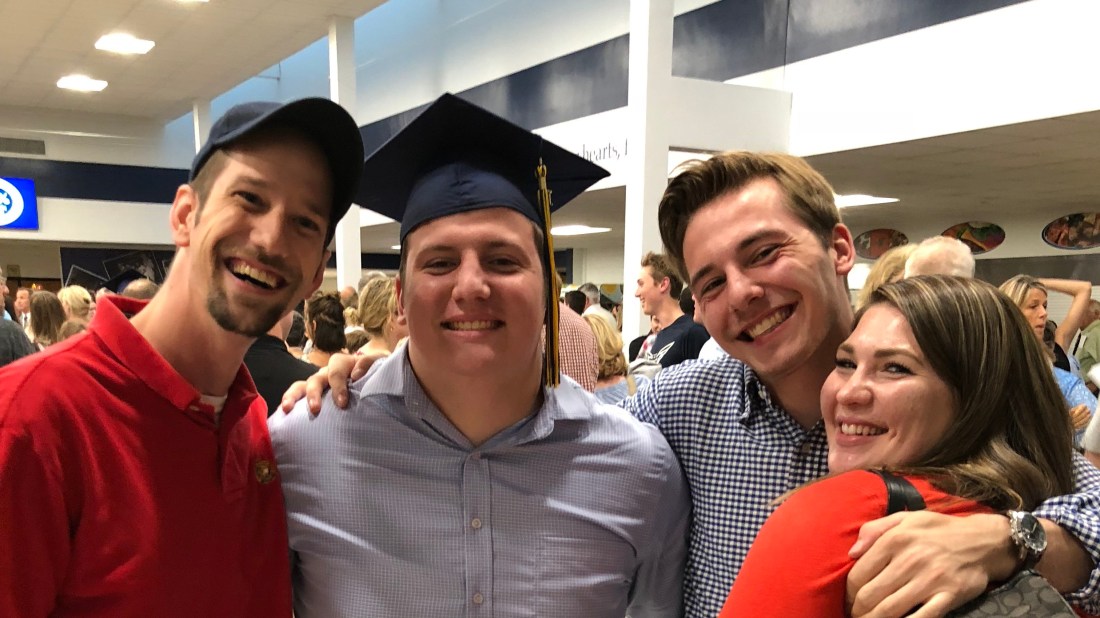
Hi! My name is Ryan King, and I am pleased to introduce myself for JRM 215: Media and Digital Literacy. I am enrolled in this class as part of the JMC department core of classes, of which I am taking five this semester! I am very excited for my schedule this fall, as I get to dive head first into the journalism curriculum after changing my major at the end of my sophomore year. I am a junior from the Twin Cities of Minnesota. Above is a picture of myself with my brothers and sister-in-law at my brother’s graduation.

I have had an extensive and casual career with media. I mean that as in I have long been a consumer of media and other digital formats (the internet, social media, television, etc) but I have not necessarily taken much time to study it. My first real experience with the study of these concepts was my sophomore year taking BIA 253, studying information systems with very introductory coding, and History of American Mass Media, where we examined American news and journalism’s evolution throughout the years and its impact on significant historical events in the United States. This semester being enrolled in courses such as Media and Digital Literacy, Social Media and Digital Foundations for the Web, I am really looking forward to acquiring more “media and digital literacy” (wink wink).

As I previously mentioned, I am a regular consumer of media. I usually read the news surfing different sites on my laptop or by following news organizations’ social media accounts on my phone. I would like to think that I read up on the news more than a lot of my fellow students, but I know there’s always a bigger fish. In high school I would watch CNN in the morning while I ate breakfast, but since moving off campus, I no longer have cable television. Now the only programs I watch are mostly Netflix and Hulu, which I can watch on my Xbox in my bedroom. I find it funny that more and more people are forgoing cable in favor of streaming apps like Netflix and Hulu, or even programs that mimic cable television such as YouTube TV and Sling. I personally think these advancements are great for consumers. When I come home, I can turn on my gaming system and have access to hundreds of shows and movies through different streaming apps. I don’t even have to play a game if I don’t want to!

That being said, I recognize such a thing as too much technology, and I have been trying to diversify how I spend my free time by doing more reading and less screen time (with mixed results, albeit). It concerns me that our world is so immersed in media, as with the good comes plenty of bad. I have seen first hand that technology has the power to weaken social interaction. Every time I see two people out to eat, both staring into their phones, or I am hanging out with friends doing the same, I wonder how things used to be before technology was so dominant. There is even a difference in how I was raised versus how children now are. I see so many parents who just give their kid the iPhone or tablet when they are being disruptive at dinner. I hate to be judgmental or act like I know anything about parenting, but that just doesn’t seem right to me. Society has a lot of reckoning to do regarding technology and media’s roles within it.

Thanks to my History of American Mass Media class, I now not only analyze the news I read, but I also think critically about the news organizations that produce it and journalism in general, now that I understand journalism’s history better. What I enjoy about the news media is how well connected and advanced they are in delivering content to consumers. Large networks like CNN have strong social media presences, well-known anchors and a broad array of content beyond just headline news. What can be frustrating, however, is how some individuals and networks have allowed themselves to become politicized beyond just delivering the news. I was a frequent watcher of CNN’s morning news, then I stopped whenever when Chris Cuomo came on. While I can’t say I disagreed with his political beliefs, it bothered me in the way he clearly expressed them, through snide comments and unprofessional rhetoric in his delivery, especially regarding Donald Trump. It makes it difficult for someone like me who just wants to receive the proper information and make a judgment for myself.

This semester, I look forward to the opportunities this course will bring, and I want to leave with a better intellectual understanding of the media I surround myself with constantly. I also hope that through said understanding, I can make my media consumption more meaningful, and less wasteful and unproductive. I’m excited for a great year!

Picture taken by me.

Driving Social Engagement

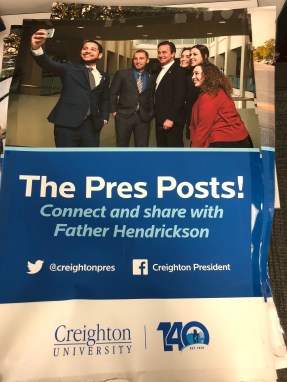
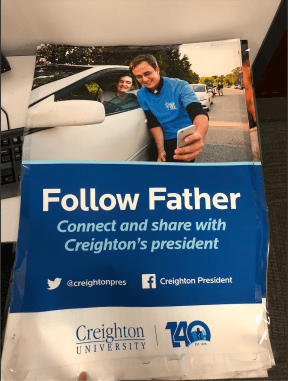
During freshmen move-in at Creighton, there are so many elements being communicated to the new faces on campus. Get a meal plan! Sign up for this club! Student Center this way! Creighton’s president, Father Daniel Hendrickson, is an important advocate and source of information for the Creighton community on social media, and our team wanted to encourage new students to follow him. Needing a clear call to action that identified him by name and as president, I wrote brief copy for two sandwich boards placed on campus.

IMG_2701            Screen Shot 2018-11-16 at 1.04.56 PM.png