
The Future of Profitable Journalism

With the digital era in full sprint, the face of journalism has never looked more different than it does today, and its future is far from guaranteed. Traditional print and cable news outlets face decreased advertising revenue, shaken public trust and competition from multi-faceted, all-digital “news” outlets. Fewer industries have been shaken by digitization more than news, and newsrooms must adapt or be destroyed. The problem at hand has been acknowledged and debated thoroughly, but no one seems to yet know how to crack the code for journalistic success in the digital age.

Nicco Mele, former publisher for the Los Angeles Times and director of Harvard’s Shorenstein Center on Media Politics and Public Policy, sat down for a Harvard University podcast to share his thoughts on the changing face of journalism. The biggest insight I took away was his belief that journalism, previously bloated and unchanging, now had to be rooted in small, scrappy organizations who had slimmer profit margins. Mele claims, “the future of journalism is small scrappy enterprises that are entrepreneurial, that are innovative, that are trying things.” He noted that for so long journalism was so large and profitable, that these expectations have not been adapted for the new era of news consumption. Attitudes and salaries are going to have to change, he says.

Personally, I agree with Mele and others in saying that journalism must survive by adopting new revenue streams while leaving their mission and voice unchanged. More subtle forms of advertising, such as influencer marketing and product placement, are fast outpacing traditional methods. Product placement in the form of native advertising can fit especially well to news organizations, including local ones. When done well, native advertising can be effectively integrated into journalistic content. My favorite example of this through native advertising is a piece done in the Omaha World-Herald for Creighton University. The sponsored article explained how strengthened local recruiting efforts helped build Creighton’s largest ever incoming class. Native advertising like this fits into the World-Herald‘s mission of Omaha-focused journalism. While this piece was paid content, it does still inform Omaha residents of local happenings. With careful application, native advertising can be an effective strategy that fits organically into the organization’s own content.

Further in line with the need for diverse revenues, traditional news organizations must look beyond advertising. Yes, advertising has grown more dynamic and personalized over the years, but it still is unhealthy for newsrooms to lean on it too much. There are more features than ever that help users skip or disable ads, decreasing their value and thus decreasing revenue from them. To insulate themselves from relying too heavily on an industry also in flux in the digital era, news organizations need to also build a strong foundation of paid subscribers. Subscriptions are not new to news by any means, but organizations need to better innovate the subscription system to allow for more people to subscribe in a variety of ways. Examining the Omaha World-Herald, my local Star Tribune in Minneapolis and even the Washington Post reveals their subscription models only vary between layers of print and digital access. I see this as a missed opportunity to add other formats of subscription as the New York Times does by also offering cooking and crossword subscriptions. By diversifying subscription bases, perhaps these organizations can engage more people who may not be interested in a comprehensive subscription, but may enjoy one cheaper and more focused. For example, the Star Tribune could run a politics subscription for a fraction of the regular price, giving users access to political news from across Minnesota (and beyond if the paper so pleased). With its extensive Huskers and general athletic coverage, the World-Herald could offer sports-only subscriptions. Lord knows there are enough die hard Huskers fans in the state who may be interested.

There are concerns that the urge to digitize and increase profitability in the Internet age will compromise good journalism. I get that. It is a legitimate worry that in search of a new business model, once proud news providers become slaves to click rates and web traffic. However, the alternative may just be destruction. If newspapers refuse to adapt at all, they will not exist much longer to provide the quality news they pride themselves on. These organizations must remain true to who they are and the content they provide, but everyone must adapt on some level in order to survive and keep fighting the good fight.
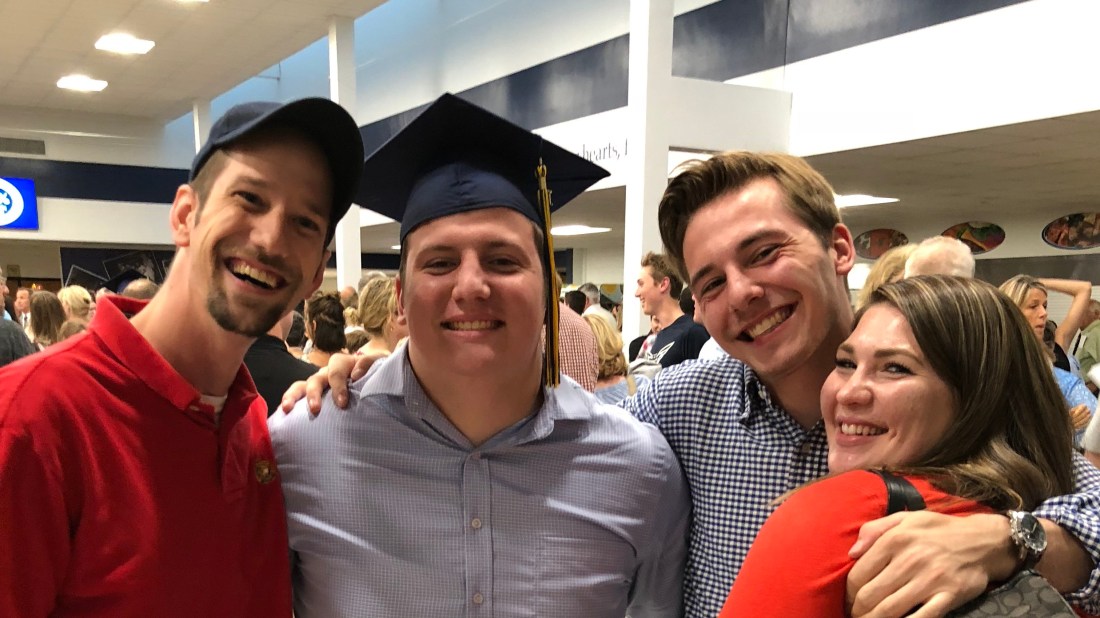
Photo from Elijah O’Donnell (@elijahsad) on unsplash.com. URL: https://unsplash.com/photos/t8T_yUgCKSM

An Introduction

Hi! My name is Ryan King, and I am pleased to introduce myself for JRM 215: Media and Digital Literacy. I am enrolled in this class as part of the JMC department core of classes, of which I am taking five this semester! I am very excited for my schedule this fall, as I get to dive head first into the journalism curriculum after changing my major at the end of my sophomore year. I am a junior from the Twin Cities of Minnesota. Above is a picture of myself with my brothers and sister-in-law at my brother’s graduation.

I have had an extensive and casual career with media. I mean that as in I have long been a consumer of media and other digital formats (the internet, social media, television, etc) but I have not necessarily taken much time to study it. My first real experience with the study of these concepts was my sophomore year taking BIA 253, studying information systems with very introductory coding, and History of American Mass Media, where we examined American news and journalism’s evolution throughout the years and its impact on significant historical events in the United States. This semester being enrolled in courses such as Media and Digital Literacy, Social Media and Digital Foundations for the Web, I am really looking forward to acquiring more “media and digital literacy” (wink wink).

As I previously mentioned, I am a regular consumer of media. I usually read the news surfing different sites on my laptop or by following news organizations’ social media accounts on my phone. I would like to think that I read up on the news more than a lot of my fellow students, but I know there’s always a bigger fish. In high school I would watch CNN in the morning while I ate breakfast, but since moving off campus, I no longer have cable television. Now the only programs I watch are mostly Netflix and Hulu, which I can watch on my Xbox in my bedroom. I find it funny that more and more people are forgoing cable in favor of streaming apps like Netflix and Hulu, or even programs that mimic cable television such as YouTube TV and Sling. I personally think these advancements are great for consumers. When I come home, I can turn on my gaming system and have access to hundreds of shows and movies through different streaming apps. I don’t even have to play a game if I don’t want to!

That being said, I recognize such a thing as too much technology, and I have been trying to diversify how I spend my free time by doing more reading and less screen time (with mixed results, albeit). It concerns me that our world is so immersed in media, as with the good comes plenty of bad. I have seen first hand that technology has the power to weaken social interaction. Every time I see two people out to eat, both staring into their phones, or I am hanging out with friends doing the same, I wonder how things used to be before technology was so dominant. There is even a difference in how I was raised versus how children now are. I see so many parents who just give their kid the iPhone or tablet when they are being disruptive at dinner. I hate to be judgmental or act like I know anything about parenting, but that just doesn’t seem right to me. Society has a lot of reckoning to do regarding technology and media’s roles within it.

Thanks to my History of American Mass Media class, I now not only analyze the news I read, but I also think critically about the news organizations that produce it and journalism in general, now that I understand journalism’s history better. What I enjoy about the news media is how well connected and advanced they are in delivering content to consumers. Large networks like CNN have strong social media presences, well-known anchors and a broad array of content beyond just headline news. What can be frustrating, however, is how some individuals and networks have allowed themselves to become politicized beyond just delivering the news. I was a frequent watcher of CNN’s morning news, then I stopped whenever when Chris Cuomo came on. While I can’t say I disagreed with his political beliefs, it bothered me in the way he clearly expressed them, through snide comments and unprofessional rhetoric in his delivery, especially regarding Donald Trump. It makes it difficult for someone like me who just wants to receive the proper information and make a judgment for myself.

This semester, I look forward to the opportunities this course will bring, and I want to leave with a better intellectual understanding of the media I surround myself with constantly. I also hope that through said understanding, I can make my media consumption more meaningful, and less wasteful and unproductive. I’m excited for a great year!

Picture taken by me.

Analyzing Twitter Accounts’ Impact

For my Social Media class, I chose eight Twitter accounts to analyze over five days. Those I followed were professionals in politics, journalism, public relations and sports, and I therefore learned to research and articulate the voice and style of a group of unique accounts. I have since applied these analysis skills to accounts of professional organizations.